
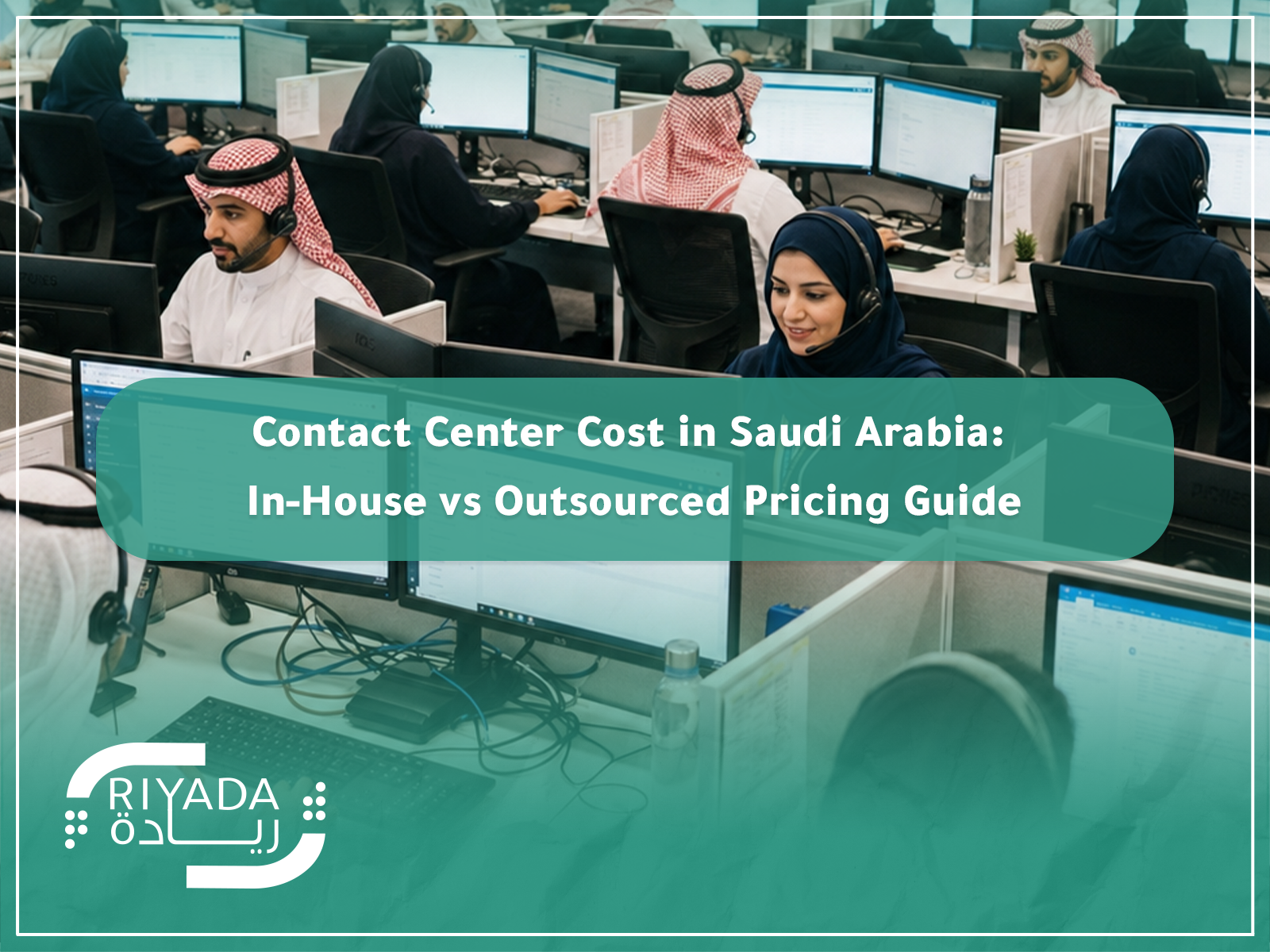
Contact Center Cost in Saudi Arabia: In-House vs Outsourced Pricing Guide
A growing volume of customer calls can quickly expose gaps in service capacity. Missed calls increase, response times become longer, and employees who were hired for other roles start spending much of their day handling customer enquiries. At that point, management must decide whether to build an internal team or work with a specialised provider.
This Contact Center Cost in Saudi Arabia: In-House vs Outsourced Pricing Guide explains the real costs behind both models. It covers staffing, technology, management, channels, scalability, and hidden operating expenses, helping Saudi businesses choose a model that supports customer experience without creating unnecessary overhead.
What Are In-House and Outsourced Contact Centers?
An in-house contact center is fully built, staffed, and managed by the company itself. The business recruits agents, purchases or subscribes to technology, creates operating procedures, manages shifts, monitors quality, and remains responsible for daily performance.
An outsourced contact center is operated by an external service provider. The provider supplies some or all of the people, systems, supervisors, quality processes, and reporting required to manage customer interactions.
The outsourced model may cover:
- Inbound customer service.
- Outbound calling campaigns.
- Order confirmation.
- Appointment scheduling.
- Complaint management.
- Technical support at the first level.
- After-sales service.
- WhatsApp and live chat.
- Email support.
- Social media enquiries.
- Seasonal or after-hours support.
Some companies also use a hybrid model. They keep sensitive, technical, or high-value customer interactions in-house while outsourcing repetitive enquiries, overflow calls, after-hours support, or seasonal campaigns.
The choice between an in-house vs outsourced call center should not be based only on the monthly price. It should be based on total cost, operational control, customer experience requirements, and the company’s ability to manage the service effectively.
Looking for effective call center solutions?
Contact us on WhatsApp to choose the right solution for managing customer calls and improving communication quality.
Key Cost Factors in Contact Center Setup
The call center setup cost in KSA includes far more than agent salaries. A realistic budget should cover the full operating model from recruitment to quality assurance.
1. Recruitment and Staffing
People usually represent the largest part of contact center costs. The business must calculate the cost of:
- Recruiting and screening agents.
- Agent salaries and employment benefits.
- Supervisors and team leaders.
- Quality assurance employees.
- Trainers and workforce planners.
- Operations managers.
- Recruitment replacements when employees leave.
- Holiday and absence coverage.
- Overtime and shift allowances where applicable.
A contact center cannot normally operate with the exact number of agents required to answer calls at one moment. Additional capacity is needed to cover breaks, training, meetings, leave, absenteeism, and changes in demand.
2. Technology and Software
A modern contact center may require several connected systems, including:
- Automatic call distribution.
- Interactive voice response.
- Call recording.
- Customer relationship management software.
- Ticketing and complaint management.
- Workforce management.
- Quality monitoring.
- Reporting dashboards.
- WhatsApp and live chat tools.
- Email management.
- Knowledge base software.
- Data backup and security controls.
Contact center technology is often priced per user, per channel, per interaction, or through a combination of subscription and usage fees. Integration with existing systems can also affect the total cost.
3. Hardware and Workplace Setup
An internal center may require office space, workstations, computers, headsets, internet connections, network infrastructure, power continuity, and acoustic preparation.
The business should also include maintenance, replacement equipment, technical support, and the cost of creating a suitable working environment for agents and supervisors.
4. Training and Knowledge Management
Agents must understand more than the company’s basic products and services. They also need training on:
- Communication standards.
- Customer verification.
- Escalation procedures.
- Complaint handling.
- CRM and ticketing tools.
- Data protection.
- Brand tone.
- Quality requirements.
- Sector-specific workflows.
Training is not a one-time cost. Product launches, policy changes, promotions, new branches, and updated systems all require continuous learning.
5. Quality and Performance Management
Contact center performance requires regular monitoring. This may include reviewing recorded calls, evaluating written conversations, coaching agents, tracking service levels, and analysing customer feedback.
Without a quality function, the company may answer a high number of contacts while still providing inaccurate or inconsistent service.
6. Working Hours and Coverage
Operating hours have a direct impact on contact center pricing. A team working during standard business hours costs less than a service that covers evenings, weekends, public holidays, or twenty-four-hour operations.
Longer coverage requires additional shifts, supervisors, technical support, and contingency planning.
7. Language Requirements
Businesses serving customers across Saudi Arabia may require Arabic and English support. Some sectors may also need additional languages.
Multilingual support can affect recruitment costs, training, scheduling, and provider pricing, particularly when each language requires guaranteed availability.
8. Service Complexity
A short order-status enquiry is less costly to manage than a technical support case requiring several systems and detailed troubleshooting.
Cost increases when agents need:
- Specialist knowledge.
- Access to multiple systems.
- Longer call handling times.
- Authority to make decisions.
- Complex identity verification.
- Coordination with several departments.
- Extensive documentation after each interaction.
9. Demand Fluctuation
Retailers, e-commerce businesses, restaurants, event organisers, tourism companies, and delivery businesses often experience seasonal peaks.
An internal team may remain underused during quieter periods but struggle during campaigns and high-demand seasons. A provider can usually offer more flexible capacity, although additional volumes must still be included in the commercial agreement.
10. Business Continuity
The cost model should account for system outages, connectivity issues, employee absences, and sudden increases in demand.
A reliable operating model needs backup processes and clear recovery procedures. These requirements may increase upfront spending, but they reduce the financial impact of service interruptions.
Learn more about call center services for businesses and how they support customer communication and daily operations.
In-House vs Outsourced Contact Center Cost Comparison
The following comparison shows where the main cost differences usually appear.
| Cost Area | In-House Contact Center | Outsourced Contact Center |
|---|---|---|
| Initial investment | Higher due to recruitment, systems, devices, and workplace setup | Usually lower because the provider already has operational infrastructure |
| Monthly staffing | Salaries, benefits, supervisors, trainers, and replacements | Included fully or partly in the service fee |
| Technology | Purchased or subscribed to directly by the company | May be included in the package |
| Recruitment | Managed and funded internally | Usually handled by the provider |
| Training | Designed and delivered internally | Provider delivers operational training using company materials |
| Quality management | Requires internal resources | Usually included within the service model |
| Scalability | Requires recruitment, training, and additional equipment | Capacity can often be adjusted more quickly |
| Seasonal demand | May require temporary hiring or overtime | Can be priced as flexible or campaign-based capacity |
| Management burden | High | Shared with the provider |
| Operational control | Direct | Managed through service agreements and reporting |
| Hidden costs | Turnover, downtime, unused capacity, management time | Setup, integrations, additional volumes, or out-of-scope services |
| Predictability | Can vary significantly by month | Often easier to forecast when scope is clearly defined |
Outsourcing is not automatically cheaper in every situation. Similarly, an internal center is not always more expensive over the long term.
The correct comparison should measure the cost of delivering the same working hours, channels, response targets, quality controls, management coverage, and technical capabilities.
Explore call answering services in Saudi Arabia and their role in reducing missed calls and improving response times.
When an In-House Model Makes Sense

Building an internal contact center may be the right decision when the service is strategically important and the company has enough scale to support a dedicated team.
The Interaction Volume Is High and Stable
An internal operation may become financially reasonable when the company receives a large and predictable number of contacts throughout the year.
Stable volumes make staffing and capacity planning easier and reduce the risk of paying for employees who are not fully utilised.
Customer Service Is a Core Competitive Advantage
Some businesses compete largely through their customer experience. They may prefer direct control over recruitment, coaching, incentives, and service culture.
This can be important for premium brands, financial institutions, technology platforms, and companies with long-term customer relationships.
Enquiries Require Deep Internal Knowledge
An in-house team may be more suitable when agents need detailed knowledge of complex products, internal processes, pricing exceptions, or sensitive customer situations.
However, complexity alone does not rule out outsourcing. It means that training, access controls, and escalation procedures must be more carefully designed.
The Business Already Has the Necessary Infrastructure
A company may already have CRM tools, contact center technology, office capacity, training teams, and operational managers. In this case, expanding an existing internal function may be more efficient than building from zero.
Management Wants Direct Daily Control
An internal model allows management to communicate directly with agents, adjust priorities immediately, and coordinate closely with sales, operations, finance, and product teams.
This control has value, but it also requires management time and specialist operational skills.
Read more about customer support services in Saudi Arabia and how they help businesses improve customer satisfaction.
When Outsourcing Becomes the Smarter Option
Call center outsourcing in Saudi Arabia is often the better option when a company needs speed, flexibility, specialist management, or lower upfront investment.
The Business Needs to Launch Quickly
Recruiting, training, equipping, and managing a new team can take significant effort. An experienced provider can usually begin operations faster once the scope, systems, scripts, and training requirements are defined.
This is particularly useful for product launches, new applications, new branches, and temporary campaigns.
Contact Volumes Are Seasonal or Unpredictable
A BPO contact center in Saudi Arabia can help companies adjust capacity according to demand instead of carrying a large fixed team throughout the year.
This model suits businesses affected by:
- Promotional campaigns.
- Ramadan and seasonal demand.
- Tourism periods.
- Events and exhibitions.
- Product launches.
- Admission periods.
- Delivery peaks.
- Appointment campaigns.
The Company Is Still Growing
Startups and medium-sized businesses may need professional support but may not yet have enough volume to justify separate agents, supervisors, trainers, quality analysts, and workforce planners.
In this case, call center packages for businesses can provide access to a broader operating structure at a manageable scale.
The Company Needs Several Channels
Running phone, WhatsApp, email, live chat, and social media internally may require several systems and different operating procedures.
A provider with omnichannel capability can manage these channels through a unified process, helping customers receive consistent information regardless of how they make contact.
After-Hours Coverage Is Required
Evening, weekend, and holiday coverage can make internal staffing more complex. Outsourcing can provide extended coverage without requiring the company to build a complete multi-shift operation.
Management Wants to Focus on Core Operations
A property company, healthcare provider, retailer, logistics business, or education platform may prefer to focus internal resources on its main services while a specialist provider manages customer interactions.
The Company Needs Better Reporting and Quality Control
Providers can offer structured performance management, including response times, call abandonment, first-contact resolution, customer satisfaction, complaint trends, and quality scores.
These reports help management understand service demand rather than simply knowing how many calls were answered.
Discover the best call center companies in Saudi Arabia and compare the services they provide to businesses.
Contact Center Cost in Saudi Arabia: How Pricing Models Work
There is no single pricing model for all contact centers. Contact center provider pricing may be based on one or more of the following structures.
Per Dedicated Agent
The company pays for one or more agents assigned mainly or fully to its account. This model is suitable when volumes are stable and the business needs a team with strong product knowledge.
Pricing may include agent salary, supervision, systems, training, reporting, and workplace costs, depending on the contract.
Per Shared Agent or Shared Capacity
Agents handle enquiries for several businesses according to defined processes. This model may suit companies with low or irregular contact volumes.
It is often more affordable, but the company should review coverage guarantees, response targets, and training arrangements carefully.
Per Hour
The client pays for scheduled operating hours. This can work for temporary campaigns, outbound calls, appointment confirmation, or limited support periods.
Per Interaction
Pricing is based on completed calls, messages, emails, tickets, or conversations.
The definition of an interaction must be clear. For example, a WhatsApp conversation containing several messages could be counted as one case or multiple interactions, depending on the agreement.
Per Minute
This model may be used for inbound or outbound voice operations. The company should understand whether waiting time, after-call work, and unsuccessful outbound attempts are included.
Monthly Package
Monthly packages may include a defined number of agents, hours, interactions, channels, and reports.
These packages can make budgeting easier, but the business must understand overage charges and exclusions.
Performance-Based Pricing
Part of the fee may be linked to outcomes such as confirmed appointments, completed sales, qualified leads, collections, or renewed subscriptions.
This model requires clear definitions and reliable tracking to avoid disputes over results.
Hybrid Pricing
Many operations use a combination of a fixed monthly fee and variable charges for extra volumes, additional channels, extended hours, or performance outcomes.
The best model is the one that matches the company’s demand pattern and allows costs to be forecast accurately.
Learn about call center management companies in Saudi Arabia and how they manage teams, systems, and performance.
Steps to Estimate Cost by Channels and Team Size
A reliable estimate should begin with operational data, not with a request for the lowest monthly price.
Step 1: Estimate Contact Volume
Calculate expected daily, weekly, and monthly volumes for each channel:
- Inbound calls.
- Outbound calls.
- WhatsApp conversations.
- Live chat sessions.
- Emails.
- Social media messages.
- Support tickets.
Use peak-hour volume as well as monthly averages. A center may receive most of its calls during a few busy hours, which affects the number of agents required.
Step 2: Measure Average Handling Time
Estimate how long each interaction takes, including the conversation and the work completed after it.
A three-minute information call requires less capacity than a fifteen-minute complaint involving several systems.
Step 3: Define Operating Hours
Clarify whether the service will run:
- During standard working hours.
- In split shifts.
- During evenings.
- On weekends.
- During public holidays.
- Twenty-four hours a day.
Longer operating hours usually require more than a proportional increase because additional supervisory and support coverage may also be needed.
Step 4: Set Service Level Expectations
Determine how quickly calls should be answered, messages should receive a response, and complaints should be resolved.
Higher service standards require additional staffing because the operation must preserve available capacity during demand peaks.
Step 5: Calculate Agent Capacity
An agent cannot spend every working minute interacting with customers. Capacity calculations must include breaks, meetings, training, absence, system delays, and after-contact documentation.
A realistic staffing calculation prevents underestimating the required team.
Step 6: Add Supervisory and Support Roles
Depending on team size and complexity, the operation may require:
- Team leaders.
- Quality analysts.
- Trainers.
- Workforce planners.
- Reporting specialists.
- Technical support.
- An operations manager.
These roles are sometimes included in an outsourced package but must be budgeted separately in an in-house model.
Step 7: Add Technology and Integration Costs
List the required tools, user licences, telephony usage, CRM access, ticketing, reporting, recordings, security controls, and integration work.
A low-priced service may become costly if every integration or additional report is charged separately.
Step 8: Include Growth and Peak Capacity
Estimate future volumes, planned branch openings, marketing campaigns, and seasonal demand.
A model designed only for current volumes may need expensive changes after a few months.
Step 9: Compare Total Annual Cost
For an internal model, include:
- Recruitment.
- Salaries and benefits.
- Management.
- Systems and licences.
- Devices and workspace.
- Training.
- Quality assurance.
- Turnover and replacement.
- Overtime.
- Business continuity.
- Unused capacity during quiet periods.
For outsourcing, include:
- Setup fees.
- Monthly service fees.
- Usage charges.
- Additional channels.
- Integration costs.
- Peak-volume charges.
- After-hours coverage.
- Out-of-scope requests.
- Internal vendor management time.
This produces a fairer comparison of customer service outsourcing cost against the real internal cost.
How to Reduce Call Center Costs Without Damaging Service
Efforts to reduce call center costs should focus on eliminating waste and repeated contacts rather than simply reducing the number of agents.
Practical measures include:
Reduce Avoidable Contacts
Analyse why customers are contacting the business. If many calls concern delivery status, appointment confirmation, or password resets, automated updates and self-service options can reduce unnecessary volume.
Improve First-Contact Resolution
Give agents accurate knowledge, suitable authority, and access to the systems they need. Solving the issue during the first interaction reduces repeat calls and customer frustration.
Forecast Demand More Accurately
Use historical data to schedule agents around real peaks instead of applying the same staffing level throughout the day.
Integrate Customer Systems
When agents can view orders, appointments, previous complaints, and customer data in one place, handling time becomes shorter and errors decrease.
Standardise Common Processes
Clear scripts, workflows, templates, and escalation paths reduce unnecessary variation and help new agents become productive more quickly.
Use the Right Channel for Each Request
Not every customer interaction requires a phone call. Simple confirmations can be handled by messages, while complex or sensitive cases may be better handled by voice.
Start With a Defined Outsourcing Scope
A company does not have to outsource everything. It may begin with overflow calls, after-hours support, outbound confirmations, or one digital channel before expanding the service.
Explore the types of call centers in the Saudi market and understand the differences between inbound, outbound, and blended centers.
Common Mistakes in Contact Center Budgeting

Budgeting errors can make either model appear cheaper than it really is.
Comparing an Agent Salary With a Full Outsourcing Package
An outsourcing package may include supervision, recruitment, quality, reporting, systems, and workplace costs. Comparing it with one salary produces an inaccurate result.
Ignoring Employee Turnover
Contact centers can experience regular recruitment needs. Advertising, interviewing, onboarding, and training replacement agents create real costs.
Using Average Volume Only
Monthly averages hide peak demand. Understaffing peak hours leads to missed calls, longer queues, and lost sales.
Forgetting After-Call Work
Agents often need time to document interactions, update systems, or coordinate with another team. This work must be included in capacity calculations.
Budgeting for Voice Only
Many customers expect support through WhatsApp, email, chat, and social channels. Adding these later may increase systems, staffing, and management costs.
Choosing the Cheapest Provider
A low price may exclude reporting, training, supervision, integrations, or sufficient staffing. Poor service can create a greater financial loss through missed sales and customer churn.
Failing to Define Scope
The contract should state which channels, hours, languages, contact volumes, reports, systems, and processes are included.
Ignoring Internal Management Time
Outsourcing still requires an internal owner who provides updates, approves decisions, reviews reports, and coordinates with other departments.
Overbuilding an Internal Center
Some companies purchase advanced technology and recruit a large team before validating actual demand. Starting with a smaller or outsourced model may reduce risk.
Treating All Interactions as Equal
A simple information request and a complex complaint require different handling times, skills, and escalation levels. Pricing should reflect the interaction mix.
Read our guide to the best call center and contact center companies and the key factors to consider when choosing a provider.
FAQs About Contact Center Cost
How much does a contact center cost in Saudi Arabia?
The cost depends on team size, operating hours, channels, languages, technology, contact volumes, service complexity, and performance targets. A detailed estimate requires operational data rather than a single standard price.
Is an outsourced contact center cheaper than an in-house team?
It can be cheaper for startups, medium-sized businesses, seasonal operations, or companies that need several capabilities without building a full team. For very large and stable volumes, an internal model may become more economical over time.
What is included in contact center outsourcing pricing?
Depending on the provider, pricing may include agents, supervisors, systems, training, quality monitoring, reporting, telephony, and workplace costs. The scope should be confirmed before comparing offers.
What affects customer service outsourcing cost?
The main factors are contact volume, average handling time, working hours, language requirements, channels, required skills, reporting, integrations, and service-level targets.
Can a company outsource only part of its contact center?
Yes. Common options include outsourcing overflow calls, evening support, WhatsApp, outbound campaigns, order confirmation, appointment scheduling, or after-sales service.
What is the best pricing model for a growing business?
A monthly package or hybrid model may be suitable because it provides predictable base costs with flexibility for additional demand. The right choice depends on how stable the contact volume is.
How many agents does a company need?
The number depends on interaction volume, handling time, peak-hour demand, operating hours, response targets, and agent availability. Dividing total calls by working hours is not sufficient because breaks, training, absence, and after-call work must be included.
Are software costs included in outsourced packages?
They may be included, but this varies by provider. Businesses should ask whether CRM, call recording, ticketing, WhatsApp, dashboards, and integrations are covered.
How can a business compare provider quotations?
Create one requirements document and ask every provider to price the same channels, hours, volumes, languages, reports, integrations, and service levels. This makes comparisons more accurate.
Can outsourcing support multiple branches?
Yes. A central outsourced team can manage enquiries for several branches, provided it has updated information, clear routing rules, and access to relevant schedules or systems.
Is outsourcing suitable for regulated or data-sensitive sectors?
It can be, but access controls, confidentiality, customer verification, data handling, recording, and escalation requirements must be defined according to the company’s sector and policies.
What hidden costs should businesses look for?
Possible hidden costs include setup, integration, additional licences, excess interactions, extended working hours, new training requirements, custom reports, storage, and out-of-scope operational changes.
The right answer to Contact Center Cost in Saudi Arabia: In-House vs Outsourced Pricing Guide depends on the total operating requirement, not the lowest visible monthly fee. An internal model can provide direct control and long-term value at sufficient scale, while outsourcing offers faster setup, flexible capacity, and access to specialised contact center management.
Riyadah helps businesses assess contact volumes, channels, team requirements, working hours, and service targets before designing the appropriate operating model. Contact Riyadah to discuss your customer service needs and develop a contact center solution aligned with your current operations and growth plans.
